

For telecommunications
Automation for telecommunications providers
The customer should never have to ring to ask what is happening with their order. We build the orchestration, the status and the reconciliation that makes that true.
Where it goes wrong today
An order needs four portals and two internal teams to provision. Each step works, the sequence is fragile, and if one portal is slow the whole order silently stalls until somebody notices.
Then the customer calls, and the answer requires opening each portal in turn to reconstruct the state.
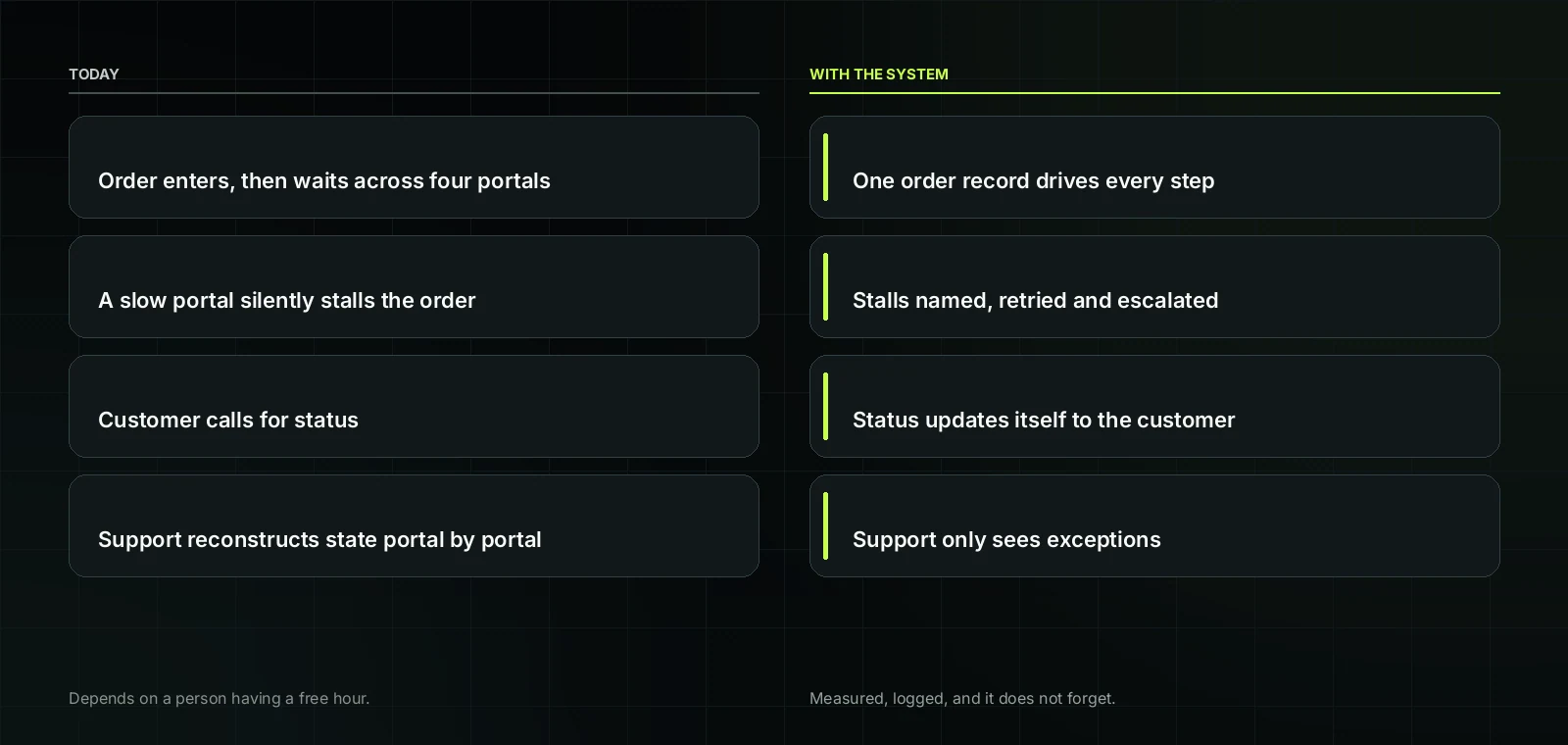
The same job, before and after.
The systems we build
Provisioning orchestration
- One order record driving every downstream step
- Retries with backoff instead of silent stalls
- Stalls detected and escalated with the failing step named
Order and activation visibility
- Status kept current from real system state
- Customer facing updates generated without a support call
- Internal view that shows where and why it is waiting
Service to billing reconciliation
- Active service compared against billing records continuously
- Exceptions flagged with the discrepancy, not just a count
- Corrections proposed for approval rather than applied silently
Support load reduction
- Repeat questions answered from live order state
- First response drafted with the actual status attached
- Agents spend their time on exceptions only
How it fits together
It sits above the portals and systems of record rather than replacing them. Orchestration and visibility are the usual first deployment, because they remove the support calls that only exist because nobody can see the state.
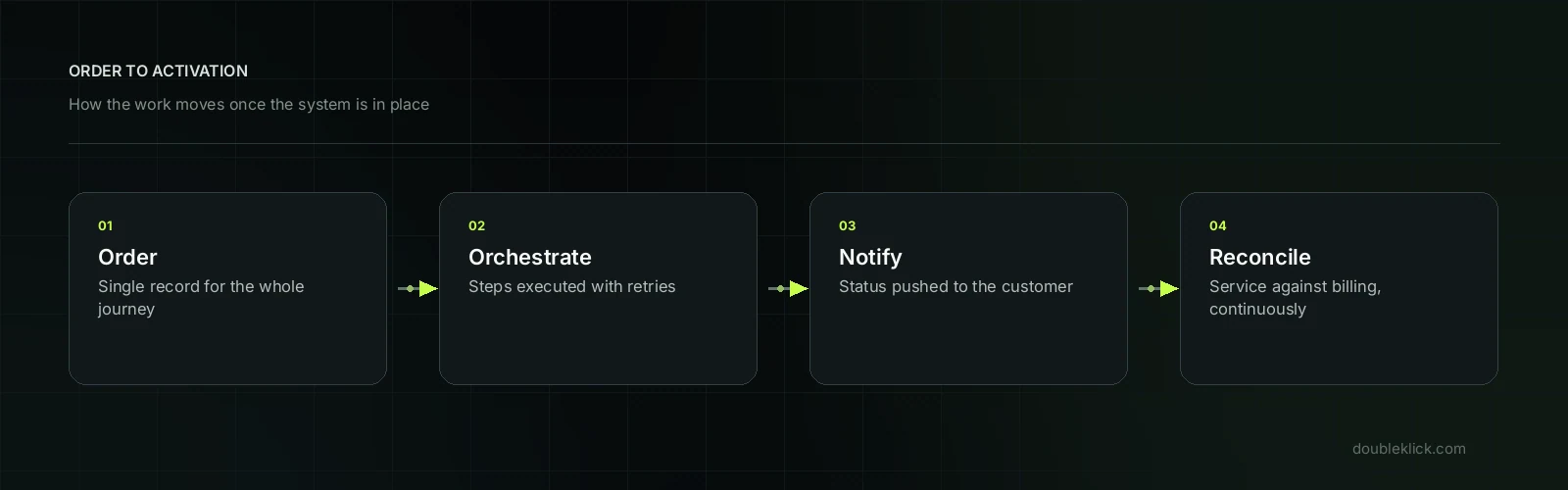
How an enquiry moves once the system is in place.
What actually changes
Orders stop stalling silently. Support call volume drops because the status is visible. Reconciliation becomes a daily report with named exceptions rather than a quarterly project.
Questions we get asked
Can you integrate with portals that have no API?
Where a portal has only a manual interface we automate what is automatable and give a person a checklist for the rest, with state tracked.
How do you handle scale?
The orchestration is queue based, so volume changes cost, not correctness.
Is customer data exposed?
No. Access is least privilege, and every automated action is logged.
What about legacy systems?
They are usually where the value is. We wrap them, we do not rip them out.
Next Step
Twenty minutes finds the first two jobs worth automating.
We will tell you which ones to leave alone as well, and why.