
Real estate
The admin is not the job.
It is what stops the job getting done.
Portals, CRMs, trust accounting, inboxes and three generations of spreadsheets. We build the layer that joins them, so an enquiry is answered in minutes, a vendor can see what was actually done, and your principals get a number instead of a story.
Where a large agency actually loses money
No agency loses money on the headline work. Listings get won, managements get signed, buyers turn up to inspections. The loss is in the seams between those things: the enquiry that arrives at 7:40pm and gets answered at 10am, the buyer who enquires twice and is called twice by two different agents, the landlord who approves a repair on the phone and disputes the invoice six weeks later, and the principal who cannot say what the group's appraisal to listing conversion was last quarter without a week of exports.
None of those are people problems. Every one of them is a missing system. In a two person office the gaps are absorbed by the owner working longer. At four offices and forty staff they become a structural cost, and the business stops being able to see itself: each office reports its own version of the truth, and the number at the top is assembled from four spreadsheets that disagree.
The reason this is worth fixing now is that the rail gauge has changed. Buyers and vendors now expect a response in minutes and a written record of everything, and the portals have made the first thirty minutes of an enquiry the whole game. The agency that answers first wins the appointment, and the agency that can prove what it did for a vendor keeps the management at review time.
What we do is build the layer underneath all of it: one intake, one record, a clock on every response, and reporting that comes from live activity instead of from memory. It is not a new CRM and it is not a chatbot on the website. It is the plumbing that makes the systems you already own behave like one business.

The handoff tax
Every handoff in an agency has a cost that nobody invoices. The enquiry handed from a portal to an inbox, the buyer handed from one agent to another, the maintenance request handed from a property manager to a trade, the approval handed back from a landlord. Each hop loses time and fidelity, and each one is invisible in the accounts because the people absorbing it are salaried.
The picture below is the same job done twice. On the left is the version that depends on people being available and remembering. On the right is the version where the record is created once and the system carries it. The work does not disappear. The waiting, the rekeying and the re-asking do.
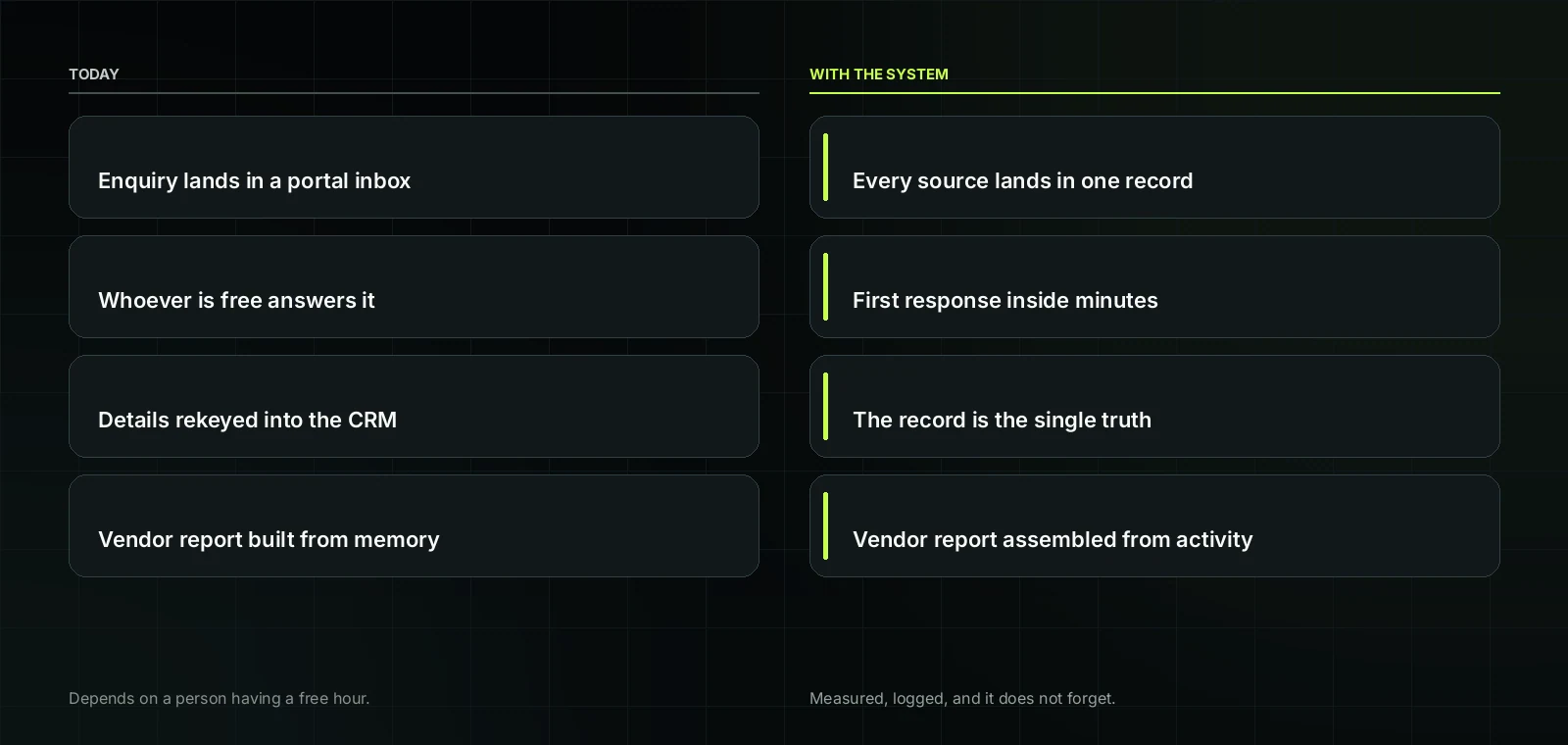
The same job, before and after.
Built, not pitched
We are not going to fill this page with logos you cannot verify. Here is what exists, described precisely, with the sector and the scale kept in and the client's name kept out.
A national property investment advisory group
They came to us with about nine and a half offshore admin positions to replace. We recorded their process, scoped it lane by lane against their own words, built the intake and CRM plumbing first, and put six agent lanes on a dedicated environment with off-site backups, monitoring and managed patching. Client data is not used to train models, and nothing sends as them. Scale: a 9.5 FTE function mapped lane by lane, six agent lanes, one isolated tenant.
A buyer's agency deal network
A distribution platform for property deals: white-labelled agency portals, a client deal room on signed and expiring links, first-acceptance handling, and a wallet ledger. Agencies see their own brand, buyers see one clean room per deal, the operator sees every allocation. Scope: 32 routes, 12 tables, agency white label, a client deal room and a ledger, built and running.
The estate behind it
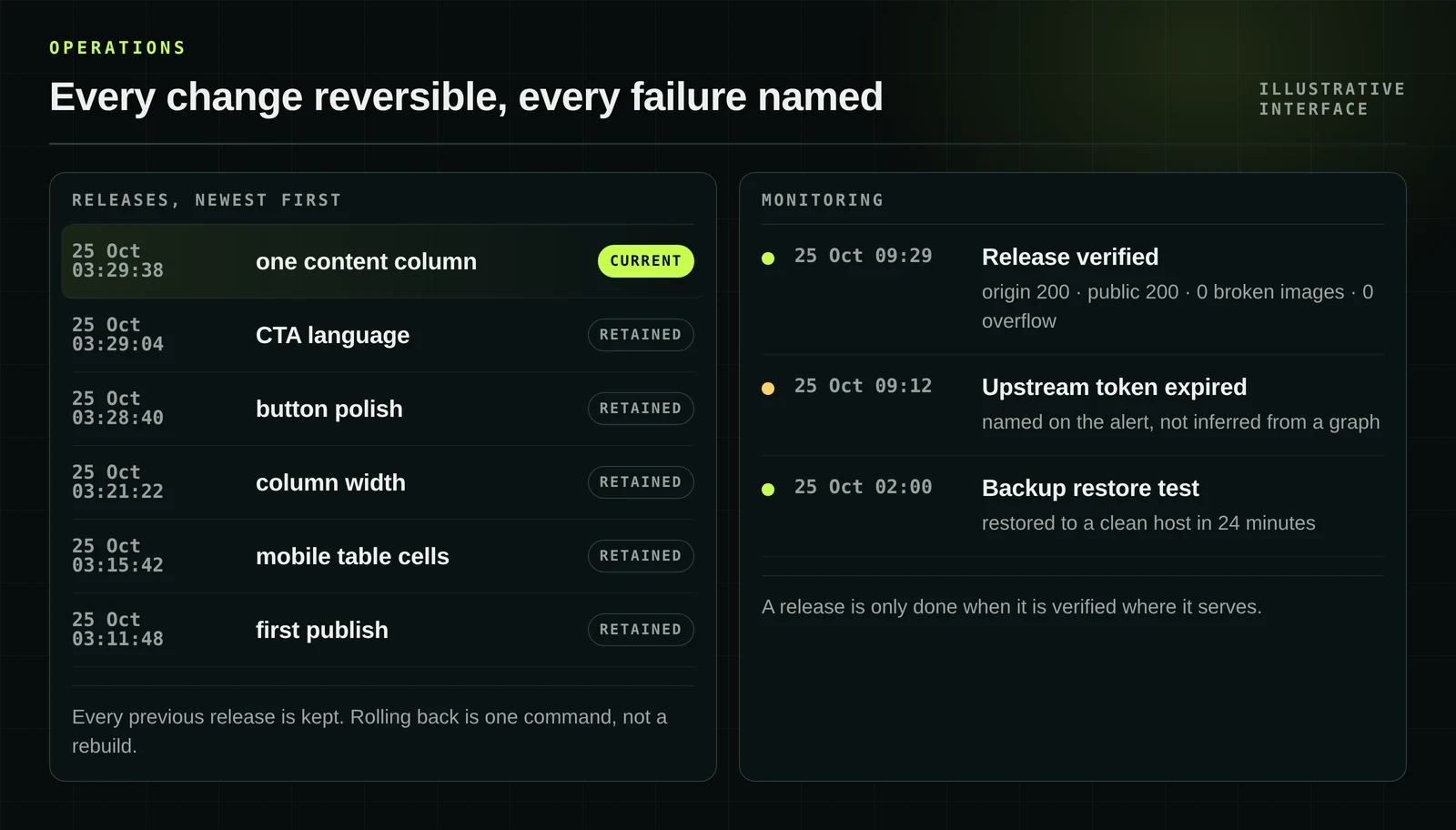
Every client environment runs on the same discipline we sell: immutable releases with one command rollback, tested backups held off site, alerting that names the cause, and client data kept apart per client rather than shared in one tenancy. Practice: every release reversible, backups restore tested rather than assumed, per client isolation.

The systems we build
Eight systems, in the order we usually build them. Each one is independently useful, each one replaces something specific that you are doing by hand today, and each one produces a number that did not exist before.
| System | What it does | Replaces | Measures |
|---|---|---|---|
| One intake, every source | Portal APIs, website forms, phone, email and social DMs merged into a single record, with duplicates matched on phone and email so a buyer sees one agency instead of two. | Four inboxes and a spreadsheet | Response time per source, duplicate rate |
| Response clock and routing | Every enquiry carries a deadline. Routing by suburb, price band, agent ledger and availability, with escalation to a person when the clock runs down. | Whoever sees the email first | Time to first response, unanswered rate |
| Appraisal and listing pipeline | Appraisal requests acknowledged immediately, then a follow up sequence that runs whether or not the agent is free, with every touch written into the vendor's record. | A reminder in one person's calendar | Appraisal to listing conversion |
| The database worked properly | Segments built from behaviour you already have: last enquiry, last inspection, suburb, price band, sold elsewhere, investor or owner occupier. Campaigns triggered by events rather than by a mailout calendar. | An untouched list and a monthly blast | Calls booked per campaign, dormant reactivation |
| Property management triage | Tenant requests logged with photos and a written trail, landlord approval captured with a timestamp, trade allocation by licence and availability, and statutory clocks counted down in the open. | An inbox and a phone | Days to resolve, requests past statutory clock |
| Arrears and compliance ladders | One escalation ladder applied the same way every time, with the letter, the call and the notice all producing a dated record that stands up when it is challenged. | A property manager's judgement and memory | Arrears days, ladder compliance rate |
| Head office visibility | One dashboard across every office: pipeline, conversion, response time, portfolio churn, arrears, maintenance ageing. Per office, per agent, updated from live data rather than from monthly returns. | Four exports and a spreadsheet | Reporting lag, per agency and per agent metrics |
| The integration layer | Your CRM stays the record of truth and your trust accounting stays where it is. The system sits between them, feeding cleaner data in and pulling the reporting out. | Manual rekeying between three systems | Rekeying hours, unmatched record count |
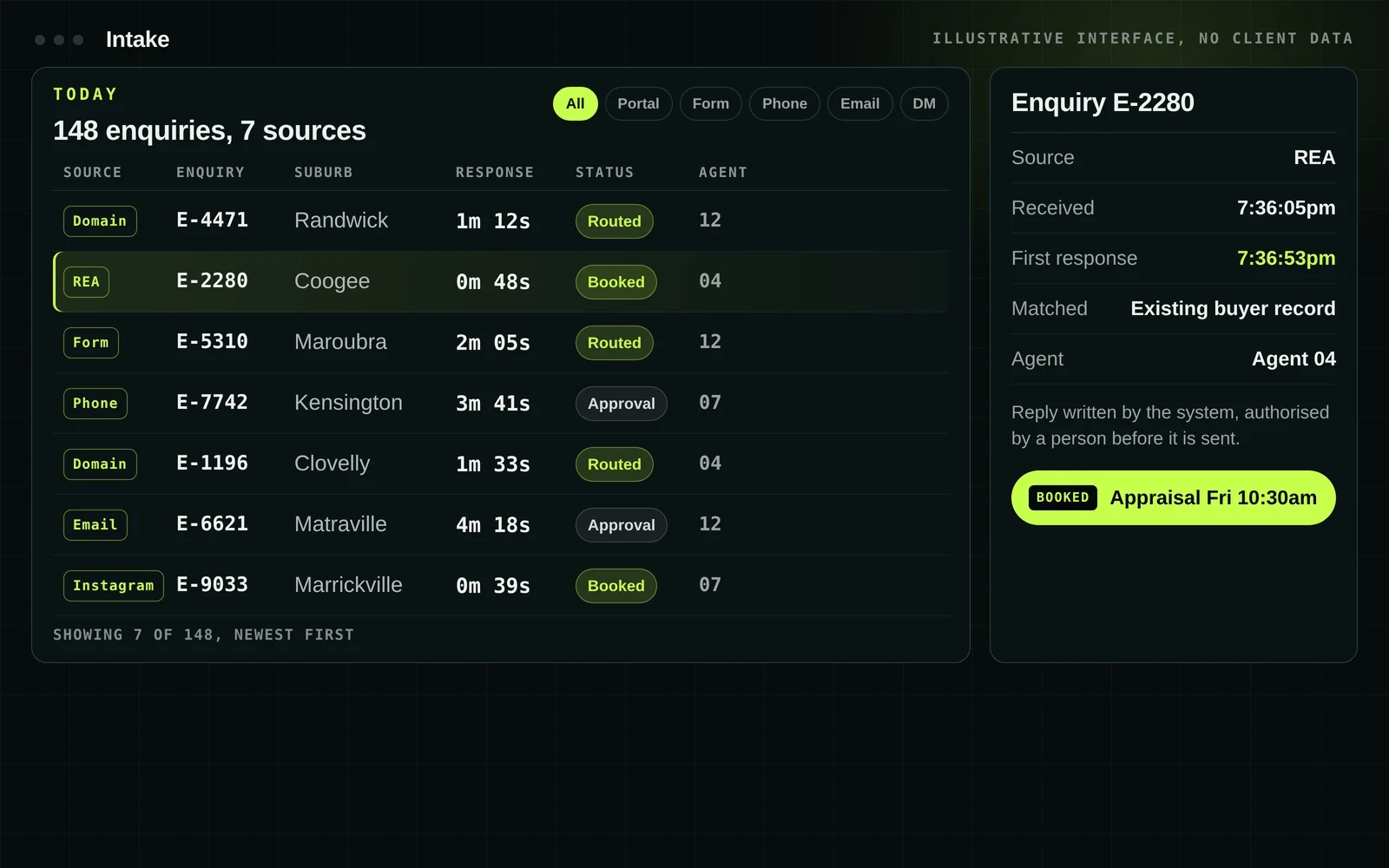
One enquiry, start to finish
Here is the whole arc on one page. Capture, qualify, route and prove: four steps, each with an owner and a clock, and a written record at the end of it that a vendor or a principal can read without asking anyone.
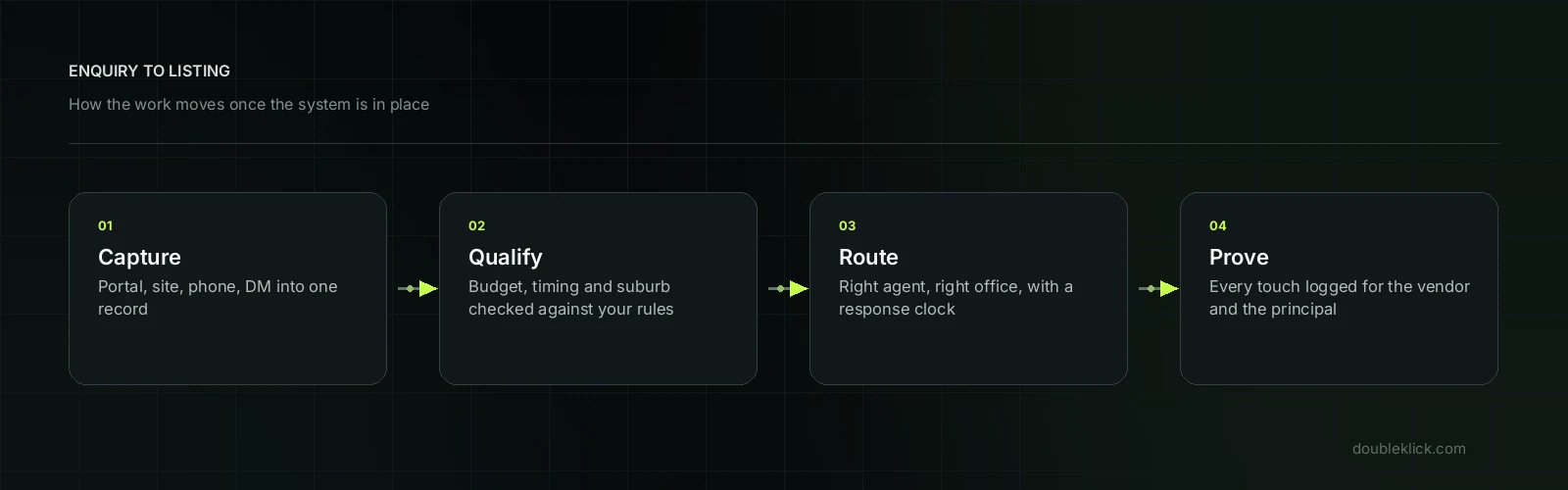
How an enquiry moves once the system is in place.
The last step is the one most systems skip. Proving it means the vendor report is assembled from what actually happened, not from what someone remembers at the end of the month, and the principal's dashboard is a by-product of the work rather than a separate job.
Applying takes about as long as explaining the business once.
The application asks what the agency does, where the week actually goes, what you already run, and what you would hand over first. That is the scoping conversation in writing, before anyone puts a number on a system.
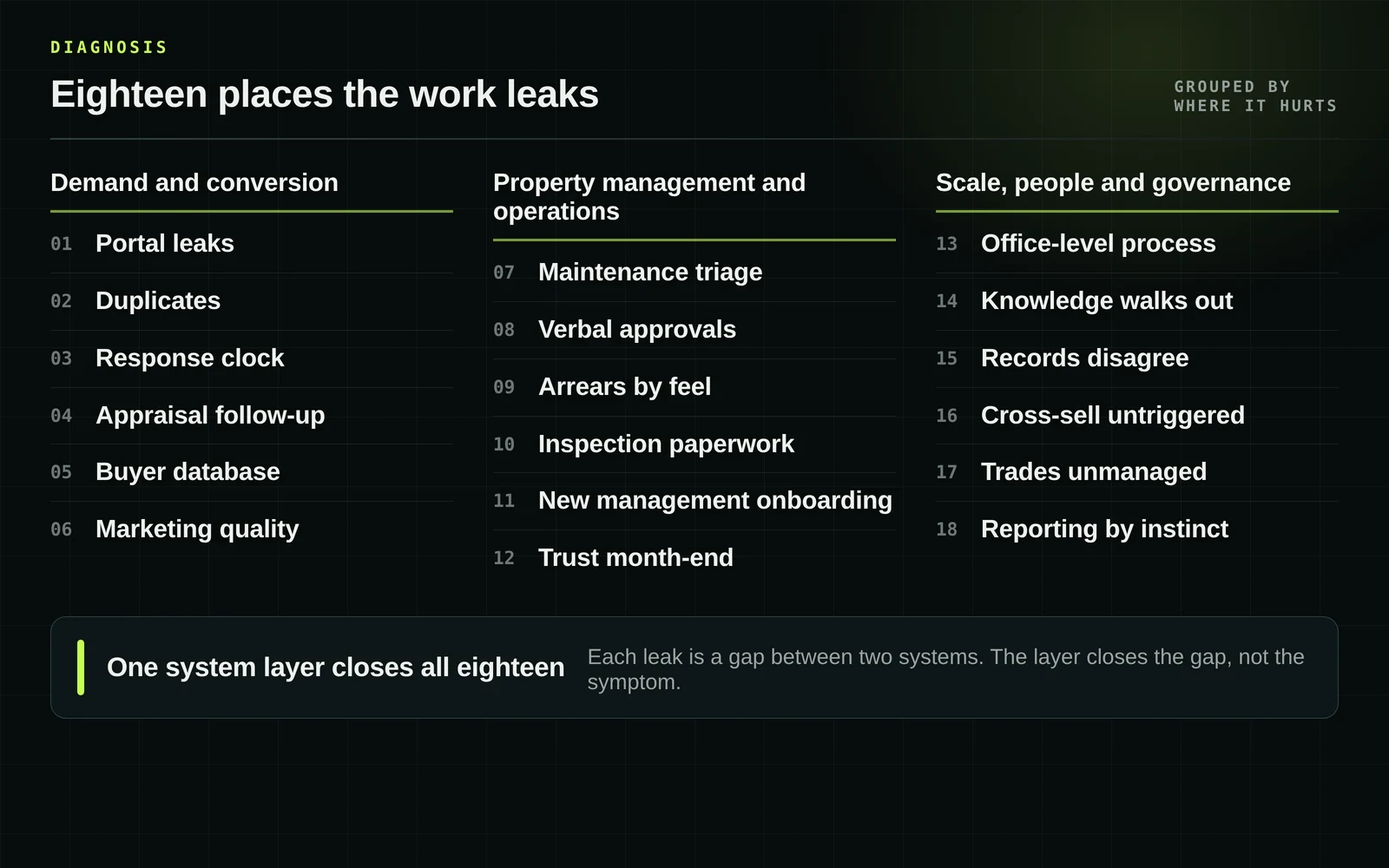
Eighteen places the work leaks
This is the list we work from in a diagnosis. A large agency will recognise most of it and will be able to add its own. We are not suggesting you fix all eighteen at once, and we would argue against trying.
Demand and conversion
- Portal lead leakage Enquiries arrive on realestate.com.au, Domain, your own site, Facebook, Instagram and the phone. They land in different inboxes with different owners, and the one that gets answered last is the one that was worth the most.
- Duplicates that cost a listing The same buyer enquiries twice through two portals and gets two agents, two phone calls and two different descriptions of the same property. The vendor hears about none of it until the complaint.
- Response time nobody owns There is no clock on the first response. It is whoever is free, and it is measured in hours when the buyer is comparing you against three other agencies in the same fifteen minutes.
- Appraisal follow up that dies A vendor appraisal is a warm lead with a long tail. Without a sequence it lives in one agent's head and dies the week they are on leave or busy with a campaign.
- Buyer database nobody works Years of contacts sit in the CRM, unsegmented. Nobody knows who is still looking, who bought elsewhere, who has equity to spend, or who should be called before the next listing goes live.
- Marketing quality by lottery Copy, photos and floor plans are produced per agent to no shared standard. The brand is the average of its least careful operator on their busiest day.
Property management and operations
- Maintenance triage in an inbox Tenant requests, landlord approvals and trade quotes live in an email thread. Nobody can say which request is three days old, who is waiting on whom, or which one is about to become urgent under the statutory repair clock.
- Approvals with no written trail A landlord approves a $900 repair verbally. Six weeks later the invoice is disputed and the only evidence is someone's memory of a phone call.
- Arrears handled by feel The escalation ladder is different for every property manager. Two tenants eight days behind get treated differently, and neither has a documented trail that would hold up if it went further.
- Inspections that generate paperwork, not decisions Routine inspections produce a report and nothing else. Recommendations for rent review, maintenance and renewals are retyped later, or not at all.
- Onboarding a new management Management authority, bond lodgement, condition report, keys, utilities and owner details. Done by hand, in a different order, at every office, and the mistakes surface at the first claim.
- Trust accounting and month end Daily reconciliation, disbursements and owner statements are correct but manual, and the week before month end is spent on arithmetic instead of on the portfolio.
Scale, people and governance
- Every office invents its own process Head office cannot see the group's pipeline because each office runs its own version of the same job. Reporting is a monthly reconstruction, and the numbers do not reconcile because they were never one system.
- Knowledge walks out with the agent The BDM knows the top two hundred buyers and keeps them in their phone. When they leave, that book leaves with them, and the replacement starts from a list rather than from a conversation history.
- CRM, portals and trust accounting disagree The CRM says one thing, the trust system says another, and the marketing platform has a third copy. Duplicates are found by a customer complaining, not by a report.
- Cross-sell nobody triggers The tenant who should be a buyer, the landlord with equity, the investor with a fixed loan rolling off. The signal sits in data you already hold and nobody is watching for it.
- Trades and contractors unmanaged Insurance certificates, licence numbers, quotes and invoices in a shared folder. The one who is not insured is discovered at the claim, not at the job.
- Principals report on instinct Appraisal to listing, days on market, enquiry response, portfolio churn, arrears days. Every one of these is knowable and most are guessed, because assembling them means four exports and a spreadsheet.
What that costs, in your numbers
We are not going to invent a saving for you. What we will do is give you the arithmetic, so you can run it against your own headcount and decide whether there is a business case before you spend anything.
Run this against your business
- Number of people who touch enquiries, listings or maintenance in a week
- Hours each of them spends rekeying, chasing or reconstructing (be honest, count the calls)
- Your fully loaded cost per hour, including on-costs and the tools they need
- Enquiries per week, and the share that gets no reply within an hour
- Appraisals per month, and the share that never becomes a listing
- Managements lost at review, and the annual fee on each
How the case is built
hours lost per week = people x hours each
cost per year = hours x rate x 46 weeks
plus the listings and managements never converted
Twenty people each losing three hours a week is sixty hours. That is one and a half working weeks lost every single week, and it is the same sixty hours at every office you add.
The conversion side is usually larger and always less visible: appraisals that never listed, and managements that left at review without anyone recording why.
Illustrative arithmetic. Deliberately no dollar figure in this section: any number we printed here would be about our assumptions rather than about your agency. We will build it with your actuals in the first meeting.
The AI workforce, if you want it
Most of what is above is ordinary integration, and it works with no AI involved. Where a language model earns its place is the work that is text shaped: reading an enquiry and extracting the budget, the suburb and the timing; drafting the vendor update from the week's activity; summarising twenty maintenance threads into six decisions; writing the listing copy to your standard rather than to the agent's mood.
Where we run a full workforce, it is a small number of named agents, each with one accountable lane and one set of limits. Each one is measured against the volume it actually handles, and each one can be replaced, retired or paused without touching the others. The pattern we use, and what a lane looks like in practice:
The pipeline
Deduplication, data hygiene, portal feeds, the buyer and seller database. The least glamorous lane and the one that makes every other lane trustworthy.
Front of house
First response, follow up sequences, appraisal nurture, drafting. Everything that touches a buyer or a vendor, with sending authorised by a person.
The money
Loan and finance coordination, pre-approval chasing, refinance triggers, portfolio and cashflow models for your investor clients.
Operations
Property management rhythm: inspections, rent reviews, maintenance triage, leasing, the statutory clocks that do not move.
Controls
Documents, authorities, compliance evidence, audit trails, approvals. The lane that protects the licence and answers the dispute.
Marketing and web
Listing copy to a standard, landing pages, campaigns, the website that has to keep up with the CRM.
Three boundaries apply to every lane and we will not relax them. Nothing sends as you or as a member of your team. Your own data is the only source, so no invented properties, figures or statuses. Anything a boundary blocks goes to your operator with the reason, not into the customer's inbox.
How an engagement runs
Four stages. The first one is the only one you commit to before you know what you are buying.
Diagnose
We sit with the actual work: a week of enquiries, a month of maintenance, the exports your principals use, and the parts of the CRM nobody fills in. We come back with a written map of where the work leaks, ranked by what it costs you rather than by what is easiest to build.
- Written diagnosis with the volume and cost of each problem
- A shortlist of the two systems worth building first
- An explicit list of what not to automate, and why
Scope
One system, defined in writing before a line of code: what it does, what it does not do, which systems it touches, who approves what, how it is measured, and what the group accepts as done.
- Fixed price per system, not an open hourly arrangement
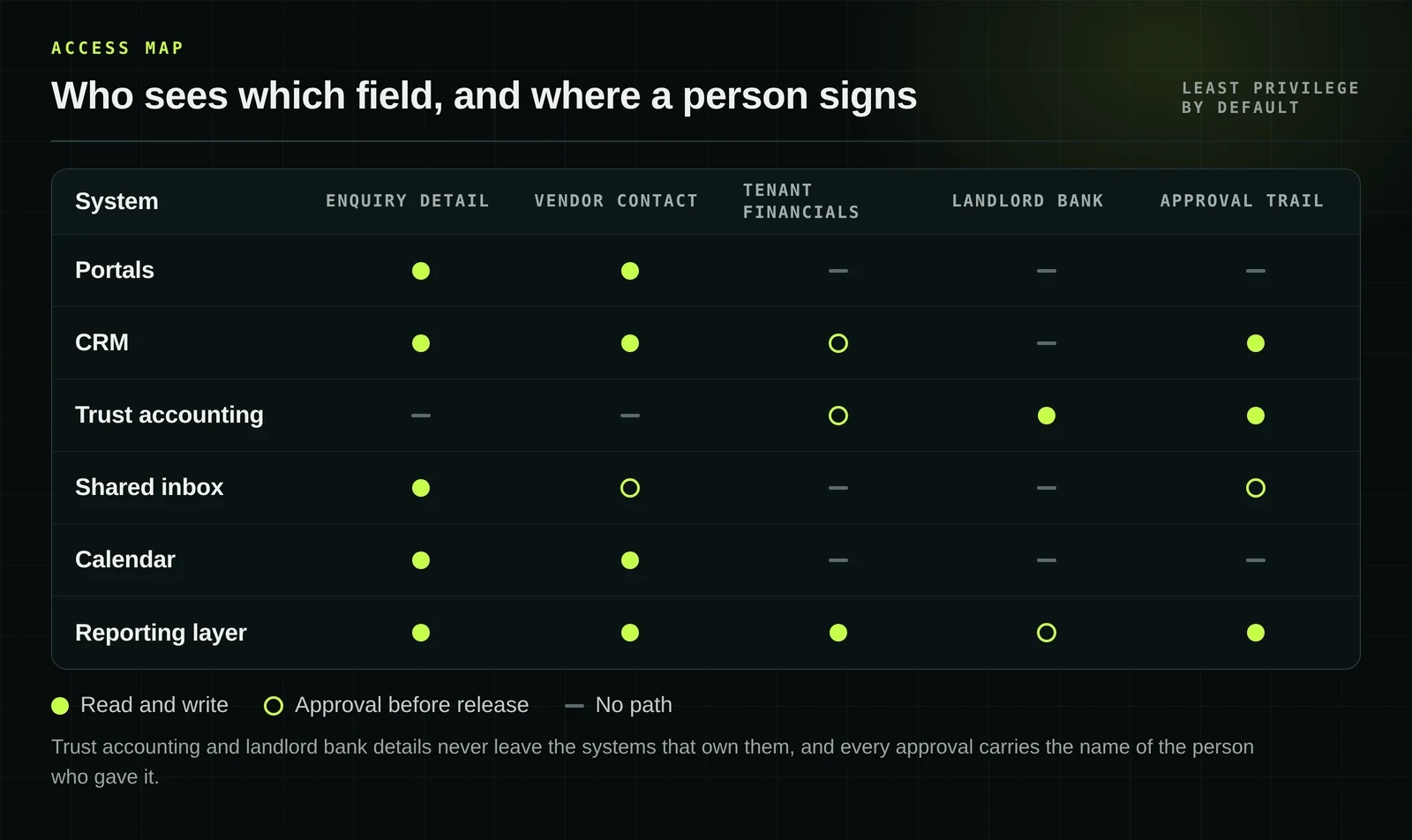
- Data and access map, field by field, agreed before build
Deploy
Built against your real data in a staging environment, tested with your people doing the work, then released with monitoring, alerting and a one step rollback. Nobody is asked to trust it on day one.
- Staged verification with your team, not a demo
- Immutable release history, one command rollback
- Alerts that name the cause, not just the symptom
Prove and expand
Four weeks of measurement before we add anything. If the first system did not move its number, we fix it before building the second. Expansion is sequenced by cashflow impact and reviewed with you monthly.
- Monthly review against the measures agreed at scope
- Each new system justified on the previous one's result
How it is measured
We agree the measure before we build, and we report it against a baseline we captured on day one. These are the ones that matter in a real estate group, and every one of them is knowable from data you already hold.
| Measure | What it tells you | Where it comes from |
|---|---|---|
| Time to first response | Whether you win the appointment or lose it to the agency that answered while you were in a meeting | Intake to reply, per source and per agent |
| Duplicate enquiry rate | How often one buyer is being treated as four leads | Matching on phone and email across sources |
| Appraisal to listing conversion | The single most expensive number in a sales office | Appraisals recorded, listings won, reason for loss |
| Enquiry to inspection rate | Whether the follow up is working or the leads are wrong | Enquiries, bookings, attendances |
| Days to resolve maintenance | Operational quality and the statutory clock at the same time | Request logged, approval captured, job closed |
| Arrears days and ladder compliance | Whether the same standard was applied to every tenancy | Ladder steps taken, dated, per tenancy |
| Portfolio churn at review | Managements leaving quietly, which nobody currently counts | Reviews held, renewals, departures and reasons |
| Rekeying hours returned | The direct labour case for the whole program | Sampled before and after, per role |
If a measure cannot be captured honestly from live data, we say so at scope rather than reporting a number we cannot defend.
Data, security and trust
A real estate group holds more sensitive data than it thinks: identity documents, bond and trust records, tenant financial hardship notes, landlord bank details, and an audit trail that a regulator or a tribunal can ask for years later. The commitments below are not aspirational. They are how the systems are built.
Least privilege, field by field
Each system sees the fields it needs and nothing else. The access map is agreed in writing at scope, before anything is connected.
Every automated action logged
Who or what did it, when, on which record, and with what result. Logs are retained so a dispute can be answered from the record.
No client data in model training
Your data is not used to train anyone's model. Where a provider is involved, that term is contractual, not assumed.
Human approval on money and legal
Nothing posts to a trust ledger and nothing is sent as your brand without a person authorising it.
Backups that are tested
Off site copies, restore rehearsed rather than assumed, and a documented rollback for every release.
Incident response that names it
If something fails, we tell you what failed, what was exposed if anything, and what we did, in writing, without being asked.
Who this suits, and who it does not
It is a fit if
- You have more than one office, or more than fifteen people touching the same work
- Your enquiry volume is high enough that response time is a competitive weapon
- You already own a CRM, a trust system and a portal subscription, and they do not talk
- Someone in the business can own the outcome, not just the project
- You want the numbers more than you want the technology
It is not a fit if
- You are looking for a website and nothing behind it
- The real problem is that the team is not doing the follow up it already knows to do
- You want an AI to speak to your vendors without a human in the loop
- Nobody can spare the two weeks for a diagnosis
- You need a result before the data is clean, because that result will be wrong
We would rather say no at the diagnosis stage than build something that gets abandoned in month three, which is where most automation programs in this industry end up.
Questions we get asked
Do you replace our CRM?
No. Your CRM stays the record of truth. We build the layer that captures work before it reaches the CRM, keeps the CRM clean, and pulls reporting out of it. If the CRM itself is the problem, we will tell you before you spend money on integration.
We already bought an AI tool and nobody uses it.
That is the usual story, and the reason is almost never the tool. It is that the tool has no access to the work: no portal feed, no phone log, no CRM write-back. A model with no plumbing is a demo. We start with the plumbing.
Will this send email as my team?
No. Drafting, preparation and follow up are automated; sending is authorised by a person. That is a deliberate boundary, not a limitation. Any system that speaks as your brand without a human check is a liability, and in a business built on trust it is a bad trade.
What about tenant and landlord data?
It stays inside systems you control. Least privilege access, every automated action logged, no client data used to train models, and no customer data copied into a third party without a written decision. We will map exactly which fields each system sees before it is switched on.
Will you touch our trust account?
We do not move money. Where reconciliation work is automated, the automation prepares and evidences the reconciliation for a person to approve. Nothing posts to a trust ledger without human sign-off.
How long before something is live?
The first system is usually live inside three to five weeks of scoping, and it is deliberately the cheapest high volume win: intake and first response, or maintenance triage. Everything after that is sequenced by cashflow impact, not by what is most interesting to build.
We have four offices with four different processes.
That is the normal starting point and usually the reason the group cannot report. We standardise the process at the system layer rather than by rewriting four sets of policies, so each office keeps its people and its local habits while the work itself becomes comparable.
What happens to our offshore team?
That is your decision and it is a people decision, not a technical one. What we can say precisely is which tasks stop being worth a person's time. Most groups redeploy rather than reduce, because the volume of work that requires judgement does not go away.
Can it handle a portfolio our size?
Volume is the least interesting constraint. Portals, mail, documents and message queues scale horizontally. The parts that need care are data quality on day one and the human approval points, and both are design decisions we make with you rather than assumptions we make for you.
What if it breaks?
Every system we deploy ships with monitoring and alerting that names the cause, an immutable release history, and a one step rollback. If it fails at 2am you get an alert that says what failed, not a morning of guesswork.
Do you need to sit inside our office?
We work remotely and we are in Sydney. What we need is access to the systems, one accountable person on your side, and a fortnightly review with the numbers in front of us. The rest is delivery.
What does it cost?
It depends on how many systems you want and how much of your data is clean enough to use. We scope in writing before any build, price per system rather than per hour, and tell you which of your problems are not worth automating. A twenty minute call will tell you whether there is a business case at all.
Apply
Tell us where the week goes.
We will tell you what to build first.
Applying is the start of the scope, not a mailing list. It asks for the goals, the work that eats the week, and the systems already in place. What comes back names the systems worth building, the order to build them in, and the measure that proves each one worked. If the honest answer is that nothing should be built yet, that is the answer you get.